Is the XREG-010 too complex?
“Every time you escalate the level of complexity, you escalate the long-term downtime for the boat, and the cost.”
Nigel Calder
“Simplicity is a form of beauty.”
Bernard Moitessier
“Go small, go simple, go now.”
Lin and Larry Pardey
The advice is unanimous. The ocean is a bad place for an autopilot that pauses when the radar reboots, an engine controller that needs the internet to reset a fault, or a failed network device that takes unrelated systems down with it.
Similar logic applies to optional equipment. A watermaker can be great for some use cases, for example, but its footprint, noise, expense, maintenance, and complexity all have to earn their place aboard. Each additional system creates another thing to understand, maintain, troubleshoot, and eventually repair.
The previous owner of my boat understood this unusually well. He had spent his life on the water and designed the boat accordingly: systems were simple, independent, and often redundant. By the time I bought Cloud Messenger, the primary chartplotter had become an iPhone, but the old hardwired units from previous decades were still aboard as backups. I laughed at the line of GPS pucks, each one looking a little more modern than the last, but they all still worked. More importantly, the failure of any one of them wouldn’t lead to any collateral damage.
It’s hard to miss this advice in sailing literature and social media, but I fully internalized it somewhere near the middle of the North Atlantic in the fall of 2024. For roughly 36 hours I ran before a Force 10 gale, the most wind I’d experienced to date, switching semi-frantically between the two available steering systems.
The Monitor windvane required no electricity, but in the worst surf it would occasionally get out of sync and round the boat up. The classic Simrad Robertson hydraulic autopilot, on the other hand, always recovered reliably. During the recent refit I had finally figured out how to connect it to the B&G Network Wind system over an early version of NMEA 0183, and with a little more rudder authority than the Monitor, it didn’t need babysitting. But it needed current from batteries that were almost dead, a story for another time (and one that leads back to this regulator).
In the end, I needed both of these systems. Their strengths and weaknesses were different, and neither depended on the other. What stuck with me was how many things simply worked, independently, at exactly the moment they had to, and I was able to get some sleep and think about these tradeoffs.
So what about the XREG-010?
It has Wi-Fi, apps, NMEA 2000 and 0183, Signal K, RV-C, Victron integration, logging, short- and long-term plotting, cloud synchronization, battery monitoring, motion sensing, weather awareness, fleet stats, and leaderboards.

It sounds a bit like the alternator-regulator equivalent of Steve Wozniak’s infamous CL-9 TV remote: perhaps technically impressive, but more complicated than anyone wants.
The discussion is open (please comment), but I think this is different, because the feature list is heavy on redundancy and light on dependency.
The critical part is still the same size
The XREG-010 has only one output of consequence: it controls current through the alternator’s field winding. More field produces more alternator output; less field, less output. That’s the extent of its authority over the boat, just like any other regulator.
Everything surrounding that function exists to make it safer, easier to configure, or to make available information useful somewhere else. The internet, your phone, the app, the Wi-Fi router, and NMEA 2000 can all disappear and the regulator will continue regulating the alternator.
Optional features fail outward
This design rule was followed tightly, and it’s a good part of the reason why this device took so long to develop. The rule is that an optional feature should fail locally rather than dragging unrelated functions down with it. Lose the cloud and we lose cloud functions. Lose a phone and we lose that particular display. If the boat router dies, we lose normal network access to the dashboard (you could still flip a switch and connect directly to the regulator’s hotspot). If NMEA 2000 goes down, the network-derived features disappear. If you get lost and mix up settings, you can reset to a known factory configuration with a toggle switch, or import one from your archives, Support, or a friend.
| What fails | What happens |
|---|---|
| Internet or cloud connection | Cloud-dependent statistics and features pause. Operation continues locally, including a month of retained history. |
| Boat Wi-Fi router | The normal network dashboard becomes unavailable, but the regulator can provide its own Wi-Fi network. Charging continues either way. |
| Phone or app | You lose that display, nothing else. |
| NMEA 2000 network | Network-derived data and integrations disappear. Local regulation and protection remain. |
| Alternator temperature sensor | The regulator detects stale data and reduces or shuts down field rather than blindly continuing at the previous output. |
| Alternator current sensor | A freshness check prevents a dead sensor from leaving field drive frozen at a dangerous value. |
| Voltage measurement | There are two: a second independent measurement provides a cross-check and will trigger a safe response. |
| Firmware hangs | A watchdog supervises the software, while an independent hardware over-voltage path can shut down the field without firmware. |
| ESP32 fails and somehow locks “on” | The hardware safety takes over and cuts the field above the configured battery voltage. |
The regulator knows the difference between losing an accessory and losing critical safety input. In the latter case, it fails conservatively instead of continuing with stale data, and notifies the operator with console messages and an optional alarm. (Push notifications are coming for app users.)
Installation and setup
Another type of complexity worth discussing: how much of this does the owner have to understand?
Due to the open-source-ness, the XREG-010 looks intimidating. It has a lot of wires, documentation pages, and settings. The curious user can read about PID loops, voltage safety margins, current limits, field energization dynamics, sensor validation, temperature control, network protocols, and literally hundreds of parameters.
But you don’t need to understand any of it to use the regulator, any more than you do with any other one.
On installation, a Commissioning Wizard asks a series of easily answerable questions: system voltage, battery chemistry and capacity, boat size, alternator type, charging equipment and a few similar basics. From those answers it populates the more obscure settings: charge voltages, safety margins, current limits, and starting values for the self-tuning control loops.
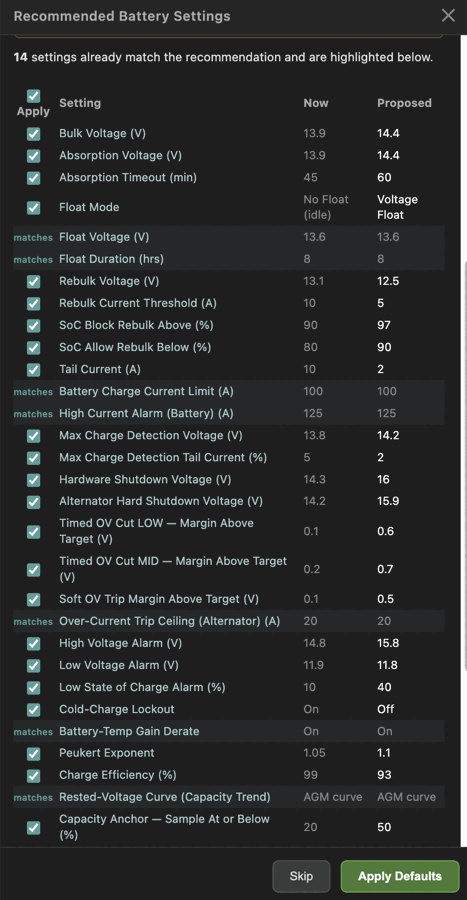
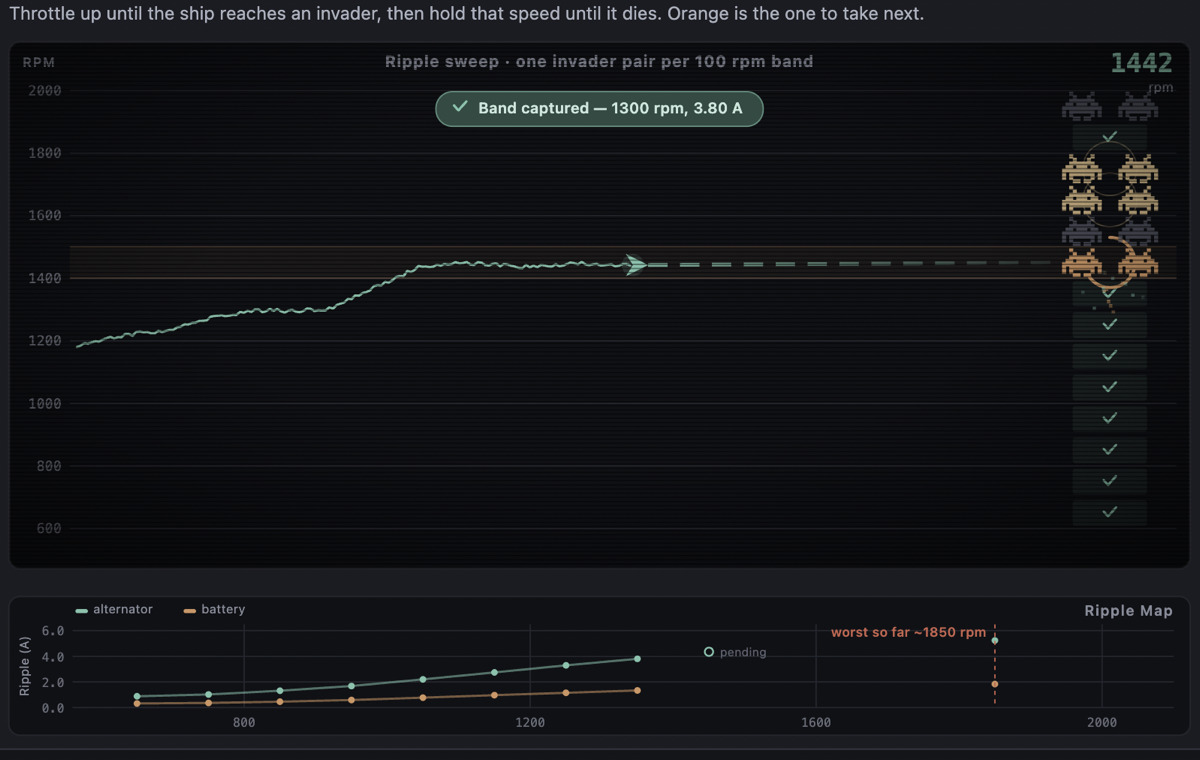
The rest of the process is guided and takes about 15 minutes. Start the engine when it says to. Move the throttle when it says to. Click Next when it says Next. One of the RPM-characterization screens is turned into a Space Invaders type game, where engine RPM moves the gun up the screen toward targets. The idea is for commissioning to be easy, and feel like something other than tuning an industrial control system. That is what’s going on, though, and an experienced installer can override all of it.
Software complexity and the charging loop
Another possible objection is whether all this extra software might interfere with the critical field control loop. If the same processor is serving dashboards, logging data, talking NMEA 2000, processing motion data, and uploading to the internet, what stops one of those jobs from delaying control?
The firmware is structured specifically around that problem. The charging loop runs on a 30-millisecond schedule and gets priority. It reads the important inputs, updates the field command and performs all the control work that affects alternator output. Logging, plotting, statistics, weather calculations, health trending, and network operations fit in around that schedule rather than sharing.
Some jobs are deliberately prohibited while charging. Establishing an encrypted internet connection and uploading stored data is the heaviest thing the processor does, so uploads wait until the field has been off and settled for more than a minute. There was no good reason to make the critical control loop compete with a cloud upload, so it doesn’t.
The final over-voltage protection is more isolated still. A dedicated battery-monitoring chip has a hardware alert output hardwired to interrupt the field excitation path. Above the configured voltage it shuts the field down without main processor involvement. A crashed ESP32 or hung software loop does not put the batteries or boat at risk.
The optional subsystems discussed here can also each be disabled individually; cloud features, integrations, solar coordination, and similar functions all have explicit toggles.
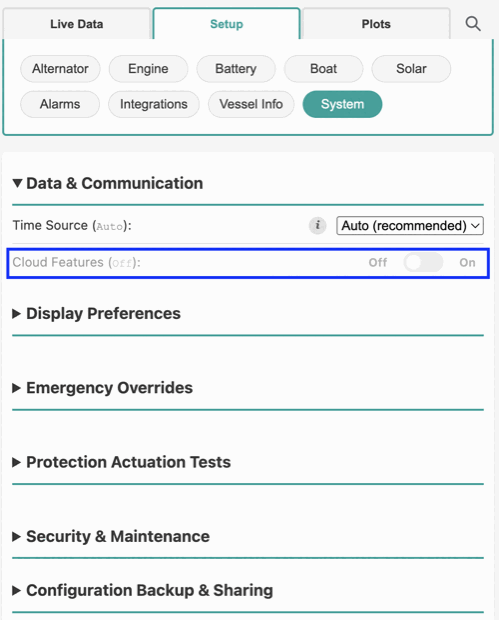
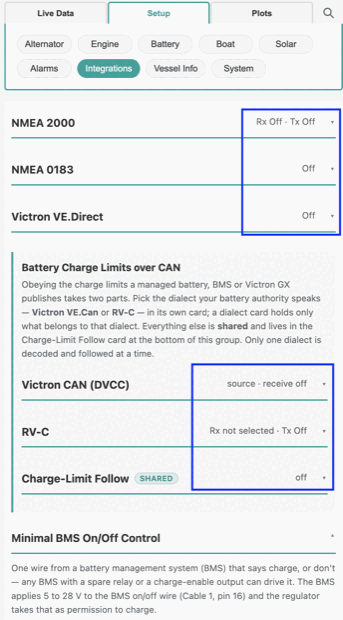
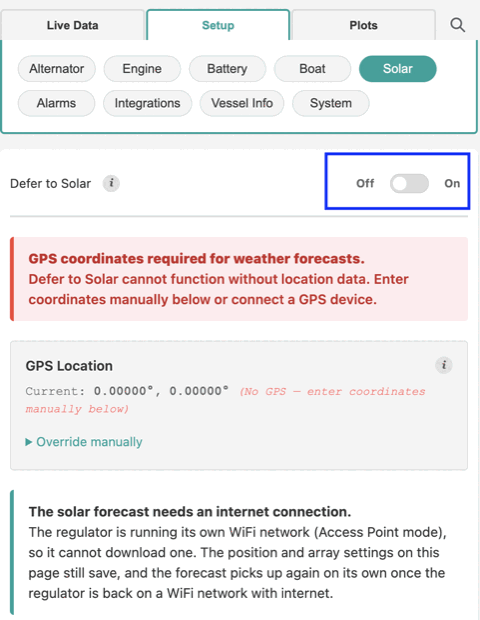
Toggling optional features off.
The open-source angle
Putting source code and schematics online does not magically make bugs disappear, and merely publishing something doesn’t mean a thousand engineers have audited it. A few people have looked closely, and I hope more will. But the immediate benefit is simpler: the behavior is inspectable. When something unexpected happens, the investigation does not have to stop at “the box decided to do that.” You can check what triggers a protection, in what order the protections run, how a sensor is validated, and what the regulator does in response.
Modern AI tools make that transparency more useful than it would have been even a year ago. You no longer necessarily need to be comfortable navigating a large C++ codebase and web app yourself; you can point it at the GitHub repository or the documentation site and ask your question. While not a complete substitute for engineering judgment, it lowers what used to be a pretty significant barrier to understanding and modification.
The same applies to hardware. Schematics and design files mean a technically capable owner or repair shop can troubleshoot the board instead of treating it as an inscrutable sealed box.
Complexity that buys redundancy
A convenient consequence of putting all the interfaces on the regulator is that it provides another way to see information that the boat has elsewhere.
The XREG-010 functions as an independent battery monitor, and displays NMEA 2000 data including GPS, wind, and other vessel information. It has its own barometer and weather-prediction features. None of this means I think you should remove the chartplotter, battery monitor, or wind display. It’s all harmless; keep it, like the old chartplotters. But when another computer dies, the XREG-010 can still show the wind instruments. If the existing battery monitor reports something weird, this is a sanity check. It’s more of the redundancy sailors have always valued.
Speaking of redundancy, probably the smartest idea for a serious offshore boat is to carry a spare, or to carry the XREG-010 as a spare to whatever you use now. It’s a relatively small part, and the harness will splice into existing wiring with no special tools. Configuration sharing between units is a few clicks of the mouse. At today’s pricing you can buy two XREG-010 units for about the same cost as one competitive product.
Conclusions
My interpretation of the opening quotes is not that every piece of equipment should be primitive. The Monitor windvane and the Simrad autopilot were collectively more complicated than either one by itself (or neither at all), and having them absolutely made the passage safer. Dual fuel filters involve more plumbing connections than one, but most feel the trade is good.
What matters is whether the added components create more useful alternatives or more dangerous dependencies. The XREG-010 contains a lot of engineering, no doubt. But it’s all transparent, and if you want you can selectively turn it all off.
Mark Nickerson
X Engineering
August 31, 2026